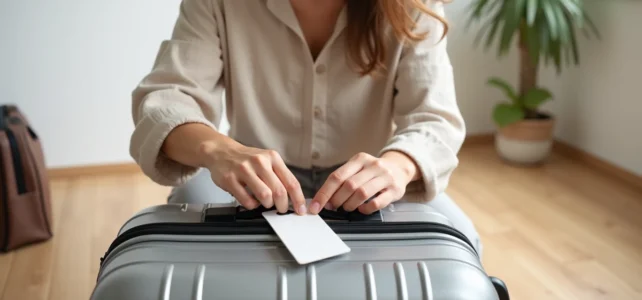
What information should be included on a suitcase label without exposing personal privacy, and what format should be chosen to ensure it remains legible after multiple flights or train journeys? The answer depends on both recent data protection recommendations and the chosen printing medium. This article compares the available luggage tag formats in PDF, analyzes the data to be included, and details the paper choices that ensure proper durability in the hold.
Personal data on a luggage tag: what the CNIL has recommended since 2023
Since 2023, the CNIL has reminded us in its file “Travel: how to protect your personal data?” that it is better to avoid the full postal address on a visible label. The identified risk: targeted burglary during vacations, facilitated by the direct reading of the address on the luggage in the boarding area or on a delivery belt.
Further reading : Discover the protein power of merguez: a surprising ally for your nutrition!
The recommendation favors a phone number and an email address as the only visible contact details. A last name is sufficient for identification by the company. This minimalist approach reduces the exposure surface while remaining compatible with the requirements of rail and air carriers.
Choosing a minimalist printable luggage tag PDF that limits the fields to the bare essentials (name, phone, email) directly aligns with these recommendations. Overloaded templates with address, flight number, and destination expose data that can be exploited by third parties.
Further reading : Discover the best types of mulch to place at the base of your hydrangeas for successful gardening!
Comparison of printable luggage tag PDF formats
The PDF templates available online differ in size, the number of tags per page, and the presence or absence of a privacy flap. The table below summarizes the characteristics of the most common formats.
| Template Type | Tags per A4 page | Privacy Flap | Proposed Fields |
|---|---|---|---|
| Business card (85 x 54 mm) | 8 to 10 | No | Name, phone, email |
| Medium format (100 x 70 mm) | 4 to 6 | Optional (fold) | Name, phone, email, destination |
| Large format with flap (75 x 110 mm folded) | 2 to 4 | Yes | Name, phone, email, address (masked) |
The business card format concentrates information on a small surface. It fits into a standard rigid tag holder. However, the absence of a flap leaves all data exposed.
The large format with flap, like the Éticôtin template offered by Sacotin, hides the contact details under a cover. The privacy flap protects the data while remaining readable by staff in case of loss. This format consumes more paper but better meets the CNIL’s recommendations.
Legibility after handling in the hold
A PDF printed on standard paper (80 g/m²) does not withstand moisture and friction from a baggage carousel well. Two options extend the lifespan of the tag:
- Print on sufficiently dense paper (like bristol) to prevent the ink from smudging upon contact with water.
- Laminate the tag with a transparent adhesive film or a thermal laminating pouch, making it resistant to multiple consecutive trips.
- Use a laser printer rather than an inkjet, as laser toner does not dissolve upon contact with moisture.
PDF paper tag and digital bag tag: two complementary uses
Since 2022-2023, Air France, Lufthansa, and SWISS have been gradually integrating digital bag tags (reusable Bluetooth/NFC labels) into their check-in systems. These electronic devices display the routing barcode directly on an e-ink screen attached to the suitcase.
The PDF paper tag then becomes a backup for personal identification rather than a routing medium. If the electronic tag malfunctions, ground staff can identify the owner using the printed contact details. Both mediums serve distinct functions.

For train travelers (SNCF, Eurostar), the digital bag tag does not exist. The paper tag remains the only means of identifying forgotten luggage on board. PDF templates compatible with the formats required by the SNCF typically measure around 100 x 70 mm, a size sufficient to be visually spotted by staff.
Speeding up a lost luggage claim with a named tag
Some travel insurers and premium bank cards mention in their 2023-2024 conditions that the presence of a named tag can speed up the processing of a lost luggage claim. This is not a contractual obligation but a valued element during the claim assessment.
A correctly filled minimalist tag (legible name, valid phone number, regularly checked email) allows the baggage service to contact the owner quickly. Without a tag, the process relies solely on matching the luggage reference number with the company’s database, which prolongs the timelines.
What the tag must contain at a minimum
- Last name in capital letters, legible from an outstretched arm’s distance.
- Mobile phone number with international code (+33 for France) if traveling outside the territory.
- Email address checked daily, preferably short to remain legible in small print.
- No visible postal address, in accordance with CNIL recommendations.
Choosing a minimalist PDF template with these four elements meets both carrier and insurer requirements without overloading the tag with unnecessary data. Printing two copies per luggage (one on the outside, one slipped inside) remains the most reliable practice for recovering a lost suitcase.