The attendance at French monuments reached record levels during the summer of 2025. This observation, documented by the Ministry of Culture in its Patrimostat 2026 report published on September 11, 2026, masks a more nuanced reality.
The proportion of French people who visited a museum or an exhibition declined compared to 2024, according to the Barometer of Cultural Outings 2025 published on September 18, 2026. Cultural practices are transforming, and the list of places or artistic forms that matter is evolving with them.
Attendance at Museums in France: The Gap Between Numbers and Practices
Major heritage institutions report solid results. Monuments are visited more than museums or temporary exhibitions. However, this dynamism conceals a phenomenon of concentration: the Île-de-France establishments capture a disproportionate share of visits, while regional structures struggle to maintain their audience.
The profile of visitors is also very distinct. Executives, higher intellectual professions, and the most educated individuals are overrepresented among museum and monument audiences, according to Patrimostat 2026. This social and geographical polarization raises a direct question: when we talk about cultural must-sees, whose must-sees are we referring to?
Publications like bigre-magazine.fr regularly document these blind spots by covering less institutional cultural forms, from live performances to digital arts, which escape the radar of major attendance surveys.

Contemporary Art and Private Foundations: A Redrawn Cultural Map
The landscape of contemporary art in France is no longer limited to public museums. Private foundations have redistributed the cultural geography over the past fifteen years. Places like the Luma Foundation in Arles or the Pinault Collection at the Bourse de Commerce in Paris offer programs that rival those of public institutions, sometimes with superior resources.
This movement raises questions. Field feedback diverges on this point: some professionals in the sector see it as an enrichment of the offer, while others worry about a gradual privatization of artistic programming. Foundations shape tastes, fund artists, and structure careers. Their influence on what becomes “necessary” deserves examination.
Galleries and Art Fairs: The Market as Prescriber
International fairs (Paris+ by Art Basel, historic FIAC) play a comparable role. They identify the artists that matter, set prices, and attract collectors. The art market shapes the very notion of what constitutes a necessary work as much as criticism or art history.
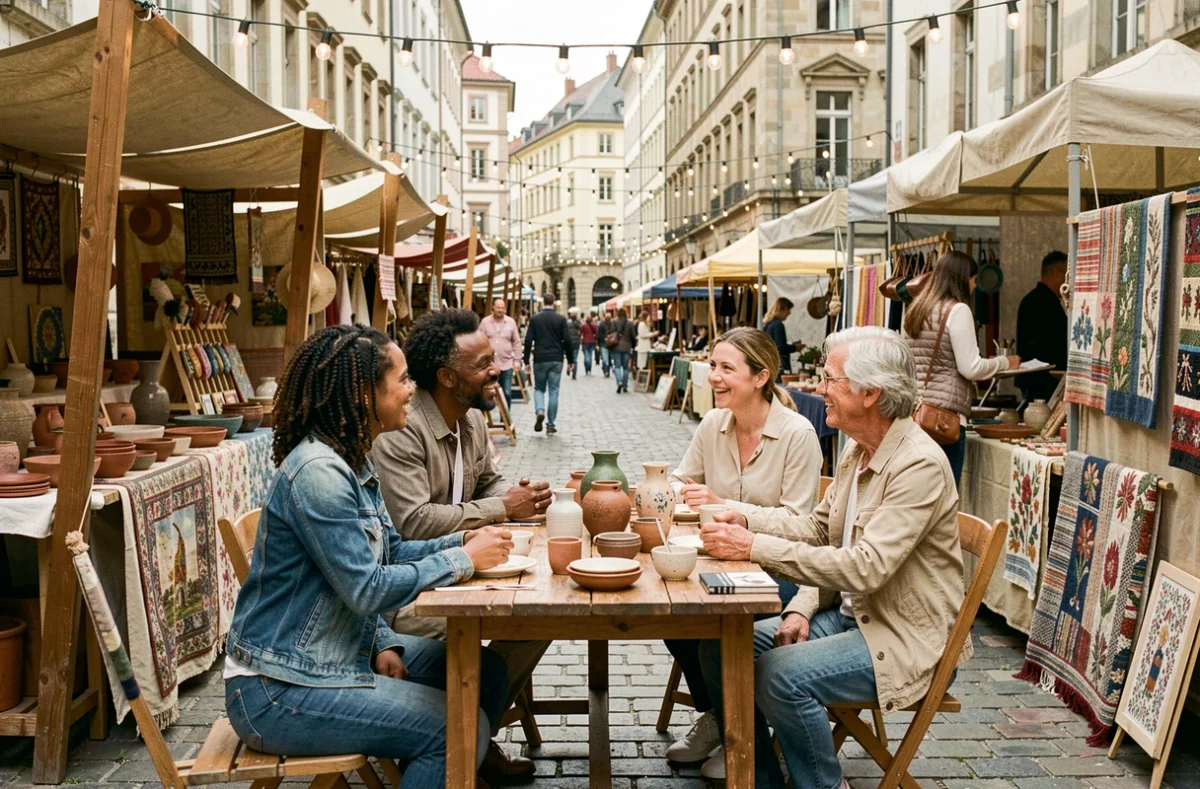
However, this market dynamic leaves entire scenes in the shadows. The figurative painting of small studios, contemporary ceramics, and textile arts remain largely invisible in these circuits, even though they attract a growing audience at fairs and creator markets.
Young Audiences and Cultural Practices: A Generational Gap
The Barometer of Cultural Outings 2025 from the Ministry of Culture provides a rarely highlighted fact: 15-24 year-olds visit cultural facilities more than their elders. This observation contradicts the discourse on the supposed disengagement of youth from culture.
However, their relationship with the arts differs from that of previous generations. Young audiences do not separate museum and festival, exhibition and performance, gallery and social network. They consume culture transversally, moving from a visit to the Palais de Tokyo to a concert in an industrial wasteland in the same weekend.
- Multidisciplinary festivals (visual arts, music, performance) attract a young audience that traditional museums struggle to capture alone.
- Social networks function as full-fledged cultural prescribers, directing visits to photogenic places or immersive exhibitions.
- Third places (wastelands, shared workshops, hybrid spaces) serve as entry points to the arts for audiences distanced from institutions.
These practices question the relevance of traditional lists of must-sees, often centered on museums and historical monuments. A significant part of cultural life takes place outside of traditional heritage circuits.
Heritage at Risk and Cultural Investments: The Limits of the Current Model
The success of attendance at major heritage sites should not obscure the state of the built environment. According to analyses reported by the specialized press in the fall of 2026, culture is facing a wall of heritage investments. Many classified monuments require restoration work, the funding for which remains uncertain.
The European Heritage Days continue to serve as a showcase. They highlight sites that are usually closed to the public and raise awareness of the fragility of certain buildings. However, the occasional mobilization of a weekend does not replace a policy of regular maintenance.
Society and Access to Culture: Beyond Lists of Places
Reducing culture to a list of museums or monuments ignores access barriers. Ticket prices, geographical distance, and feelings of social illegitimacy remain documented obstacles according to surveys from the Ministry of Culture.
The available data do not allow for concluding that mediation measures (targeted free access, Culture Pass) have significantly altered the social composition of audiences in the long term. Physical access to a place does not guarantee cultural appropriation.
The must-sees of culture do not form a fixed list. They are redefined over generations, through changes in the art market and public policies. The next edition of Patrimostat will reveal whether the slight decline in museum practice observed in 2025 has been confirmed or reversed, but the real question is less about the number of visitors than about their diversity.