
People have a dual perspective on owning rental properties. On one hand, being a landlord seems like a good plan to earn a lot of money relatively easily and safely, plus you own real estate. On the other hand, people fear the associated risks, the time to spend on them, bad tenants, but also the fact that there may be more costs than expected and other significant risks.
Owning a rental property is something that people have in mind
 Many tell each other, one day I will buy or I will have to build to rent. And then comes the day when you want to plan your retirement or for any other reason, and you think: “We could buy one or two rental properties to earn direct income and diversify our investments.”
You may also like : The latest MSC ship: Discover the jewel of the seas
We have compiled a list of pros and cons to guide you in this type of decision.
Advantages of rental real estate
The advantages of owning a rental property are relatively few; we have listed four, but they are significant. To put it simply, if everything aligns well, you can achieve an interesting return with a rental property.
Recommended read : The Mystery of Cruise Ship Names
Rent is a regular income
The biggest advantage of owning a rental property is that tenants will provide you with direct income. These monthly rents can either finance a loan if you were to take one out or directly feed your savings.
If you own a house that you rent for €800 per month, that house, once occupied, will generate €9,600 gross per year in your accounts.
It is hard to contest such a direct income stream. It is worth noting, however, that such figures can be optimistic and we should not just wait for such results. For security in your financial plan, account for a holiday of about one month per year or every 18 months, depending on the state of your rental house or the type of tenant.
Growth in rental property value
Furthermore, since you are a property owner, you stand to gain from an increase in property value over time due to changing demand in the area, even if the property itself does not undergo changes. It is common to realize capital gains as real estate prices trend upward. For example, over the last 7 years, the average price of villas has risen from €117,677 to €144,087.
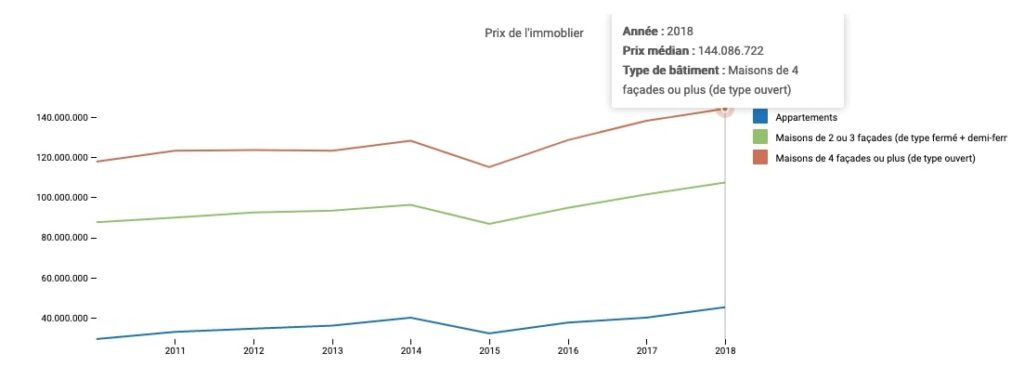
Source:
https://statbel.fgov.be This will obviously be a variable factor, as it heavily depends on the area where your rental property is located. In some regions, the value can increase significantly in a few years, while in others, it may rise more moderately. Ideally, this value growth at least keeps pace with inflation. If you are in an above-average area, your return will become very significant.
You can increase the value of your property
The other factor you need to consider is that you can always add value to the property you maintain and improve. Doing things like repainting the house, adding new siding, renovating the interior, landscaping the yard and garden, etc., will add value to the house without significant financial resource costs.
Not only will it allow you to charge more for rent, but it will also increase the property’s value if you decide to sell it in the future.
If you enjoy home improvement projects, this should be a major attraction for purchasing a rental property. You will have the opportunity to develop it at the time of acquisition as well as between tenants, which will yield very good dividends.
You can invest with part of the capital
If you have enough to cover notary fees and/or VAT, depending on whether you are building or buying an existing property, plus 10% of the purchase price, you should easily secure a loan. It is the rents that will pay off the loan, and you should always achieve a positive monthly balance. At the end of the loan term, the total rent becomes net.
Each monthly payment is a form of forced savings that your tenant is making for you.
Disadvantages of rental real estate
Every coin has its flip side, and it would not be honest not to mention the whims that a landlord may suffer. Individually, these disadvantages are relatively minor, but they must be taken into account.
Asset concentration
One of the downsides of investing in a rental property is that for most people, owning a rental property is a significant concentration of their assets.
The problem with this concentration is the lack of diversification. Whether you like it or not, by owning a rental property, you are closely tied to the local real estate market. Imagine having bought and then a factory comes to set up in the immediate neighborhood.
Asset concentration is not a good investment strategy. However, the more wealth you have, the less it becomes a risk factor, and the more owning a property becomes a tool for diversification rather than a priority.
Tenant risk
- Tenants always risk not paying their rent. This is still a minority of cases, but when it happens to you, it is very annoying and financially, it can be a cost that ruins your annual return. Of course, sometimes you will have a good tenant who pays their rent on time for years and years, but that is never a guarantee.
- Some tenants may also cause more damage than others. Of course, you will have the security deposit, but it is still a cost and a risk.
- There is also the risk of having no tenant at all, which means you will have periods of vacancy where the property generates no rental income.
Taxes, fees, and insurance
Whether the property is rented or not, you will still have to pay property taxes, the cost of insurance on the property, and if it is a collective building, the property trustee. Note that for taxes, you are subject to double taxation in Belgium since you are taxed on the cadastral income via the property tax account and the indexed cadastral income increases your income in your tax return. But rest assured, the tax on rental properties for private use is relatively low nonetheless in Belgium.
This is a fairly stable cost that you will clearly know in advance, but it remains a cost that reduces your profits. It is particularly painful if you do not have someone occupying your property, as it means these costs will come directly from your savings. But this situation is rare because the demand for rental properties is high everywhere in Belgium.
Greater personal investment than other investments
In most cases, you will need to dedicate time to this rental property:
- you will need to make various repairs at some point,
- you will need to interact with tenants,
- you will need to look for new tenants and show the property,
- you will have some administrative work, such as registering the lease, inventory,…
You can eliminate this problem by hiring a management company, but by doing so, you are planning the return on renting this property.
Conclusion
You know the ins and outs of rental real estate. It remains an opportunity to seize for the following reasons:
- regularity of income,
- low interest rates, and thus a low return on savings,
- low rates and thus mortgage credit on very good terms,
- low taxation compared to earned income.
Tag: Tax benefits from renting a property